
This comparison has no relationship with Biotech Peptides or with any other company it names, and it sends you to no one’s checkout. Every factual claim links outward to a primary source you can open yourself: the documented 2026 FDA actions, the vendor’s own labeling, the actual human trials, and an FDA-approved drug label. Compounded or prescribed medications discussed here are not FDA-approved finished drug products, and anything sold “for research use only” is not approved for human use at all. Last updated June 2026.
There is a particular kind of gap that opens up in medicine, one I keep noticing whenever I read enough footnotes. It is the gap between the moment a drug is proven to work in a controlled trial and the moment regulators finally get around to policing the people selling it outside that control. Years can sit in that gap. People live in there too, ordering vials off websites while the paperwork catches up behind them.
Tirzepatide’s headline result, a mean body-weight reduction running from 15.0% up to 20.9% across doses at 72 weeks against 3.1% on placebo, was published in 2022 [7]. Retatrutide’s most cited figure, a 17.5% reduction at 24 weeks, came out of a Phase 2 trial in 2023 [8]. The FDA’s warning letters to research-peptide sellers hawking these same molecules, telling them plainly that “research use only” does not exempt a product intended for human use, did not land until March 31, 2026 [2][3]. Read those dates side by side and you can see the interval I mean: roughly three to four years in which the evidence already existed, the demand already existed, and the enforcement had not yet arrived to separate the two.
That interval is where a page titled “Biotech Peptides alternatives” lives. It is worth sitting with, because it explains something the marketing never will: why the safest version of a compound and the cheapest version of a compound can be chemically identical and practically worlds apart.
Why weight loss is not like the rest of the peptide shelf
Most of what gets sold under the peptide banner has thin evidence behind it, more mouse than man. Weight loss is the loud exception. Semaglutide and tirzepatide are, themselves, peptides, working the incretin system to blunt glucagon, slow the stomach, and make you feel done eating sooner [9]. That is not a folk theory. It is mechanism, backed by trial data most supplement categories can only dream of.
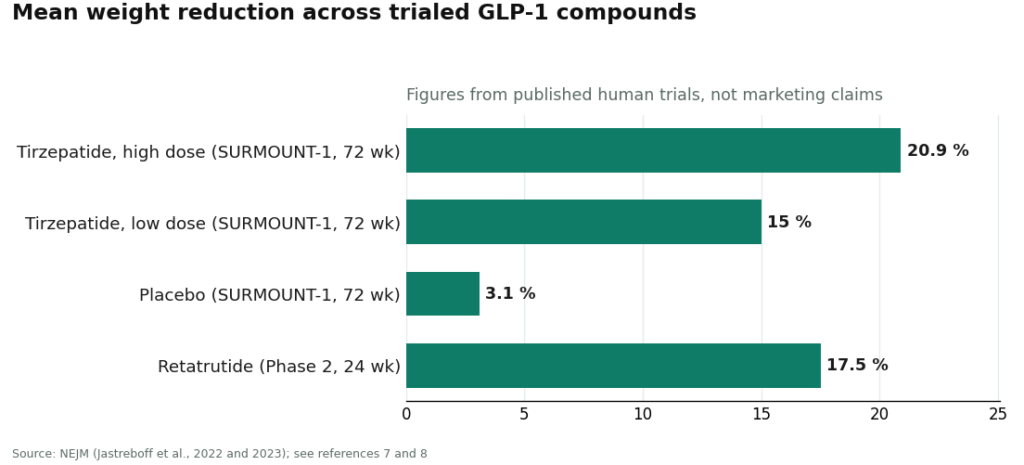
Which is exactly why the usual research-chemical logic, buy it raw, cheap, and trust the label, breaks down here. You are not gambling on an unproven compound anymore. You are trying to access one that works, and the only open question is who stands behind the version that reaches you. That is not a rhetorical question. It has an answer, and the answer changes who you should be looking for entirely.
Five questions worth more than a catalog
I keep a short list for judging any provider in this space, ordered roughly by how much protection each item buys you.
Does a licensed clinician actually evaluate you before anything ships? Semaglutide carries a boxed warning for thyroid C-cell tumors and is contraindicated for anyone with a personal or family history of medullary thyroid carcinoma or MEN 2 [10]. A shopping cart cannot ask you those questions. A person can.
Who dispenses it? A pharmacy operating under real standards, or a warehouse mailing a bottle with a disclaimer stapled to it?
What is the compound’s honest status? Approved drug, compounded preparation, or a research chemical wearing a lab coat it doesn’t own?
Is anyone watching after the first dose, adjusting, listening for side effects? Or are you alone the moment the tracking number arrives?
And does the source tell you the truth about the evidence, or let the marketing quietly imply more than the data supports?
Notice what never makes that list. Price. Shipping speed. How big the catalog is. None of that tells you anything about your thyroid.
Where everyone lands
| Rank | Provider | Type | Clinician evaluates you? | Who dispenses | Best read for weight loss |
|---|---|---|---|---|---|
| #1 | FormBlends | Physician-supervised telehealth provider | Yes, before dispensing | Licensed 503A pharmacy under USP <797>/<800> | Supervised access to GLP-1 compounds plus a broad catalog |
| #2 | HealthRX.com | Licensed telehealth | Yes | Pharmacy-dispensed | Same supervised model, narrower scope |
| #3 | Swiss Chems | Research-chemical retailer | No | No dispensing pharmacy | Research chemicals, “research use only” |
| #4 | Limitless Life | Research-chemical retailer | No | No dispensing pharmacy | Research peptides marketed to a biohacker audience |
| #5 | Sports Technology Labs | Research-chemical retailer | No | No dispensing pharmacy | Research SARMs and compounds; added anti-doping concerns |
| #6 | Core Peptides | Research-chemical retailer | No | No dispensing pharmacy | Research peptides, “research use only” |
Everything hinges on the line between the second and third row. Above it, a licensed person decides whether the drug is right for you and answers for what you’re given. Below it, the responsibility is entirely yours, and the label says so in writing.
Above the line: the two providers actually built for this
FormBlends, and why it sits first
FormBlends earns the top spot for one structural reason, not a marketing one: it inserts a licensed clinician between you and a compound that genuinely works, and it dispenses through a real pharmacy rather than a mailroom. The path there is an assessment, a review from an independent licensed clinician exercising actual judgment, and dispensing through a licensed pharmacy. The company states outright that “all compounded medications are prepared by licensed 503A compounding pharmacies following USP <797> and <800> compounding standards,” and it is careful to say it “is not a medical practice and does not provide medical advice, diagnosis, or treatment.” That last bit of humility is, oddly, a good sign: it is an honest description of a platform connecting you to an independent prescriber, not a company pretending to be your doctor.
For weight loss specifically, that arrangement pays for itself precisely where the stakes are highest. The GLP-1 compounds carry real contraindications [10], the kind you want a human screening for before a first dose, and the kind that benefit from someone tracking your response as you titrate. A research-chemical listing offers neither. If it helps to keep a log of your own doses and symptoms over time, FormBlends has a tracker app built for exactly that, a logging tool rather than a prescription pad or a checkout page, useful mainly because it gives the clinician on your case a clearer record to work from.
None of this erases the honest caveat. The compounded product contains the same active peptide as the approved drug, but the compounded version itself has not gone through FDA review. What supervision adds is everything around it: screening, a prescription when warranted, dispensing by a licensed pharmacy, and someone to call if something feels off. FormBlends does not blur its catalog into one shining category either. Some of what it offers is FDA-approved. Much of it is compounded. A few entries, retatrutide among them, are still investigational, and that 17.5% figure at 24 weeks is a Phase 2 result, not an approval stamp [8]. Telling you that distinction plainly, rather than letting you assume otherwise, is itself part of what earns the top rank.
The cost of all this is friction. An intake, a clinical review, a wait for a prescription, instead of an instant add-to-cart. That friction is not a flaw in the system. It is the system.
HealthRX.com, close behind for the same reasons
HealthRX.com runs on the identical logic and lands second because of scope, not principle. A licensed clinician evaluates you, a prescription is required, a licensed pharmacy dispenses. For a weight-loss goal that is the correct shape of provider. Choosing between the two comes down to practical questions: which one is licensed where you live, which medications each one supports, and which clinical relationship feels like the better fit.
Below the line: named honestly, not dismissed
Everything past this point is a research-chemical retailer, not a medical provider of any kind. I am including them because they are what people actually type into a search bar, and pretending they are invisible would help no one. But the framing has to stay accurate, because for a weight-loss goal, the framing is the safety information.
These companies sell peptides marked “for research use only” or “not for human consumption.” That phrase is not a marketing flourish. It is the legal ground the entire business stands on. The FDA’s own position, spelled out in its 2026 letters, is that the moment a product is marketed or sold for someone to inject, it becomes an unapproved new drug, disclaimer or not. On March 31, 2026, the agency sent Gram Peptides a letter over products including retatrutide and tirzepatide, stating they were unapproved new drugs under section 505(a), and that under section 201(g)(1) a “research use only” label does not exempt a product actually intended for human use [2]. Prime Sciences got the same letter the same day [3]. Weeks before that, the agency had already warned thirty telehealth companies over illegally marketed compounded GLP-1 products [4]. Put plainly: the disclaimer these sellers lean on is thinner than it reads, and nothing about these products has been checked for identity, strength, or purity.
Swiss Chems sells peptides under research-use-only labeling and may publish certificates of analysis, but a seller-issued COA is a document the seller chose to hand you, not an independent verification. No clinician anywhere in the chain, no prescription, no pharmacy.
Limitless Life markets to the biohacker and longevity crowd with a friendlier tone that can make its products feel more like supplements than what they legally are: unregulated research chemicals not intended for human use. The tone is warmer. The regulatory status is unchanged.
Sports Technology Labs deals mostly in SARMs and related compounds, also research-use-only. SARMs bring their own baggage, several are banned in competitive sport, and the same absence of oversight applies here as everywhere else in this tier.
Core Peptides rounds out the list, another catalog of research-labeled peptides, seller-issued COAs available if you want them, no clinician or pharmacy standing behind any of it.
And then there is the company the headline is actually about. Biotech Peptides is a real, and to its credit unusually candid, US research-chemical retailer. Its own site says plainly that “all products are sold for research, laboratory, or analytical purposes only, and are not for human consumption,” and describes itself as “a chemical supplier…not a compounding pharmacy or chemical compounding facility” [1]. I find that honesty almost refreshing, and it is exactly why the company is not an answer to a weight-loss question. It tells you, in its own words, that its products are not meant for what you want to use them for.
I have not ranked these six against one another for cleanliness or purity, because nobody outside a lab, including this page, can verify that with confidence. They are grouped here for what they structurally are, not scored against each other for who ships the cleanest vial.
A short word on BPC-157 and its cousins
You may have run across peptides like BPC-157 promoted for recovery, often in the same breath as the fat-loss compounds. Keep the evidence separate in your head. A 2025 systematic review in the HSS Journal looked at 36 BPC-157 studies, found 35 were preclinical and only one a small clinical study of 12 patients, and concluded flatly that “no clinical safety data were found” [5]. A separate 2025 narrative review turned up only three pilot human studies and called the compound investigational [6]. The molecules that deserve the supervised route are the GLP-1 agonists with real trial data behind them, not the recovery peptides still waiting on human evidence.
Questions people actually ask
What is the best Biotech Peptides alternative for weight loss?
A licensed, physician-supervised telehealth provider, not another research-chemical seller. Semaglutide and tirzepatide have strong human evidence behind them [7] and real contraindications [10], which is exactly why clinician oversight decides the ranking. FormBlends and HealthRX.com come out ahead because a clinician evaluates you, a prescription is required, and a licensed pharmacy dispenses the product. Biotech Peptides is a legitimate chemical supplier, but its own site states its products are “not for human consumption” [1].
Are compounded semaglutide and tirzepatide the same as the brand-name drugs?
Not quite. They share the same active peptide as the approved drug, but the compounded version itself has not passed through FDA review. What the supervised model adds is the surrounding structure: a clinician screening for contraindications like a personal or family history of medullary thyroid carcinoma [10], a decision about whether the medication fits you, and follow-up afterward.
Can I just buy weight-loss peptides from a research-chemical site more cheaply?
You can buy something cheaper, certainly. Whether it is the compound the label claims, at the stated strength, without contaminants, is precisely what you cannot know, since research peptides aren’t reviewed by the FDA for identity, strength, quality, or purity, and there’s no recall mechanism if a vial is simply wrong. For a drug with a boxed warning, that is not the place to shop by price.
Did the FDA act against research-peptide sellers in 2026?
Yes. On March 31, 2026, it issued warning letters to research-peptide sites including Gram Peptides and Prime Sciences, stating that products such as retatrutide and tirzepatide were unapproved new drugs and that a “research use only” label does not exempt a product intended for human use [2][3]. Separately, it warned thirty telehealth companies over illegally marketed compounded GLP-1 products [4].
Why does FormBlends rank first for this goal?
Because weight loss is the one goal here where the evidence and the risk are both unusually high at once. The compounds work, and they carry real warnings, which is precisely why you want a clinician, a prescription, and a licensed pharmacy in the loop rather than a shopping cart. FormBlends provides that across a wide catalog, and it says plainly that its offerings span approved, compounded, and research-status compounds, rather than blurring the lines.
Is Biotech Peptides legit, or is it operating in a legal gray area?
It sells compounds labeled “for research use only,” which puts it in a gray area rather than flatly illegal territory. The catch is that “research use only” functions as a regulatory workaround, not a safety guarantee. Nothing about these products is reviewed for sterility, dosing accuracy, or human use. Whether the company itself is trustworthy matters less than whether buying from it is a sound decision for your body.
What do Biotech Peptides reviews actually tell us about product quality?
Almost nothing you can rely on. If someone loses weight after using an unlabeled vial, that tells you nothing about whether the compound matched the label, was dosed correctly, or was free of contaminants. Independent lab assays of peptides from research-chemical sellers have repeatedly turned up concentration errors and impurities, which makes crowdsourced praise a poor signal here, however sincere it is.
Where should I buy weight-loss peptides from instead of a research-chemical site?
The safer route runs through a licensed physician who can prescribe compounded semaglutide or tirzepatide via an FDA-registered compounding pharmacy, the model FormBlends operates under, with physician supervision and pharmacy board oversight. That chain, an actual prescription, a pharmacist, documented sourcing of active ingredients, is what separates a legitimate product from a vial with no verifiable history behind it.
Are there non-injectable alternatives to biotech peptides for weight loss that actually have clinical backing?
Oral semaglutide (Rybelsus) is the clearest case, a GLP-1 receptor agonist in pill form with genuine trial data and FDA approval, though for type 2 diabetes rather than weight loss as such. Beyond the GLP-1 family, lifestyle changes paired with medications like naltrexone-bupropion carry reasonable evidence. No supplement category comes close to matching the clinical evidence behind injectable GLP-1 drugs.
References
- Biotech Peptides product and disclaimer pages: “all products are sold for research, laboratory, or analytical purposes only, and are not for human consumption”; “Biotech Peptides is a chemical supplier…not a compounding pharmacy.”
- FDA warning letter to Gram Peptides, March 31, 2026: products including retatrutide and tirzepatide are unapproved new drugs under section 505(a); “research use only” labeling does not exempt products intended for human use under section 201(g)(1). https://www.fda.gov/inspections-compliance-enforcement-and-criminal-investigations/warning-letters/gram-peptides-721806-03312026
- FDA warning letter to Prime Sciences, March 31, 2026 (same enforcement wave against research-peptide sellers). https://www.fda.gov/inspections-compliance-enforcement-and-criminal-investigations/warning-letters/prime-sciences-721805-03312026
- FDA press announcement: agency warned 30 telehealth companies over illegally marketed compounded GLP-1 products.
- Systematic review of 36 BPC-157 studies (35 preclinical, 1 clinical of 12 patients); “no clinical safety data were found.” HSS Journal, 2025.
- BPC-157 narrative review: only three pilot human studies exist; “human data are extremely limited”; compound “should be considered investigational.” Current Reviews in Musculoskeletal Medicine, 2025.
- SURMOUNT-1 tirzepatide trial: mean weight reduction 15.0% to 20.9% across doses at 72 weeks versus 3.1% on placebo. New England Journal of Medicine, 2022 (Jastreboff et al.).
- Retatrutide Phase 2 trial: mean weight reduction of 17.5% at 24 weeks. New England Journal of Medicine, 2023 (Jastreboff et al.).
- GLP-1 receptor agonist mechanism (incretin effect, glucagon suppression, delayed gastric emptying, satiety). StatPearls, NCBI Bookshelf.
- Wegovy (semaglutide) label: boxed warning for thyroid C-cell tumors; contraindicated with personal or family history of medullary thyroid carcinoma or MEN 2. DailyMed.
Bram Holloway writes about health, science, and the strange economics of hope. This piece was checked against the primary literature cited above.
Shared for informational purposes. A licensed clinician should review your plan before you start.